Bamboo field management
A practical guide to culm management, stand maintenance, shoot production and the sustainable 3-year harvest cycle.
Stand Structure & Culm Management
Field Age vs. Culm Age
It is important to distinguish between the age of the bamboo field (years since planting) and the age of individual culms (years since a culm emerged as a shoot). A mature bamboo field contains culms of different ages — this mixed-age structure is the basis of sustainable management.
Essential Distinction
"We cut according to the age of the CULM, never according to the age of the field."
Growth Trajectory
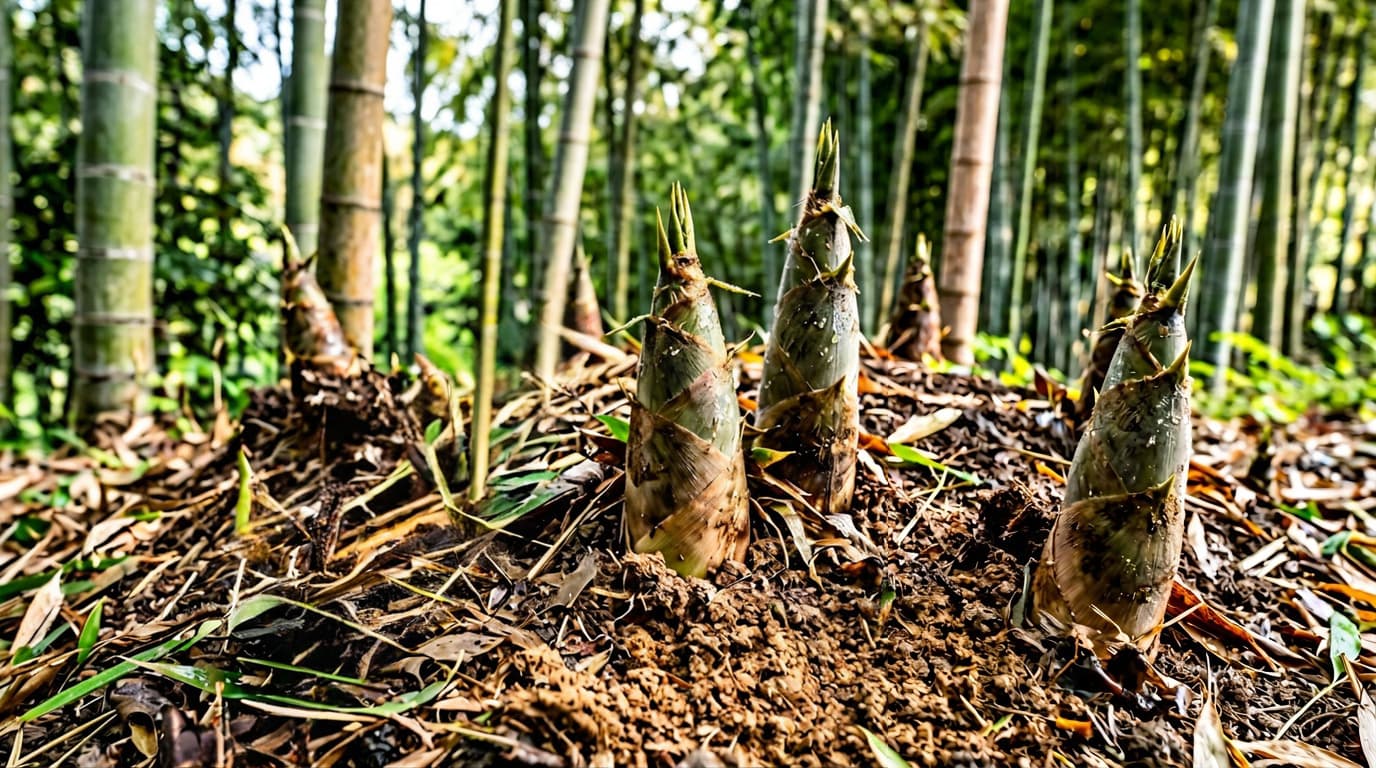
New shoots emerge each spring and reach their full height and diameter within a single growing season (typically 60–90 days). After reaching full height, culms do not grow taller — they only mature and harden over the following years. Each year's cohort of new culms tends to be larger than the previous year's, as the underground rhizome network expands.
Stable Stand Structure — 33 / 33 / 34
The recommended management model divides the standing culms into three age classes. Each year, the oldest third is selectively harvested. This maintains a balanced stand with a constant flow of harvestable culms while preserving the younger culms that feed the rhizome system.
Fresh shoots, growing, feeding the rhizome. DO NOT cut.
Maturing, producing leaves and energy. Retain for next year's harvest.
Fully hardened. Ready for harvest — cut these each year.
Visual Culm Age Identification
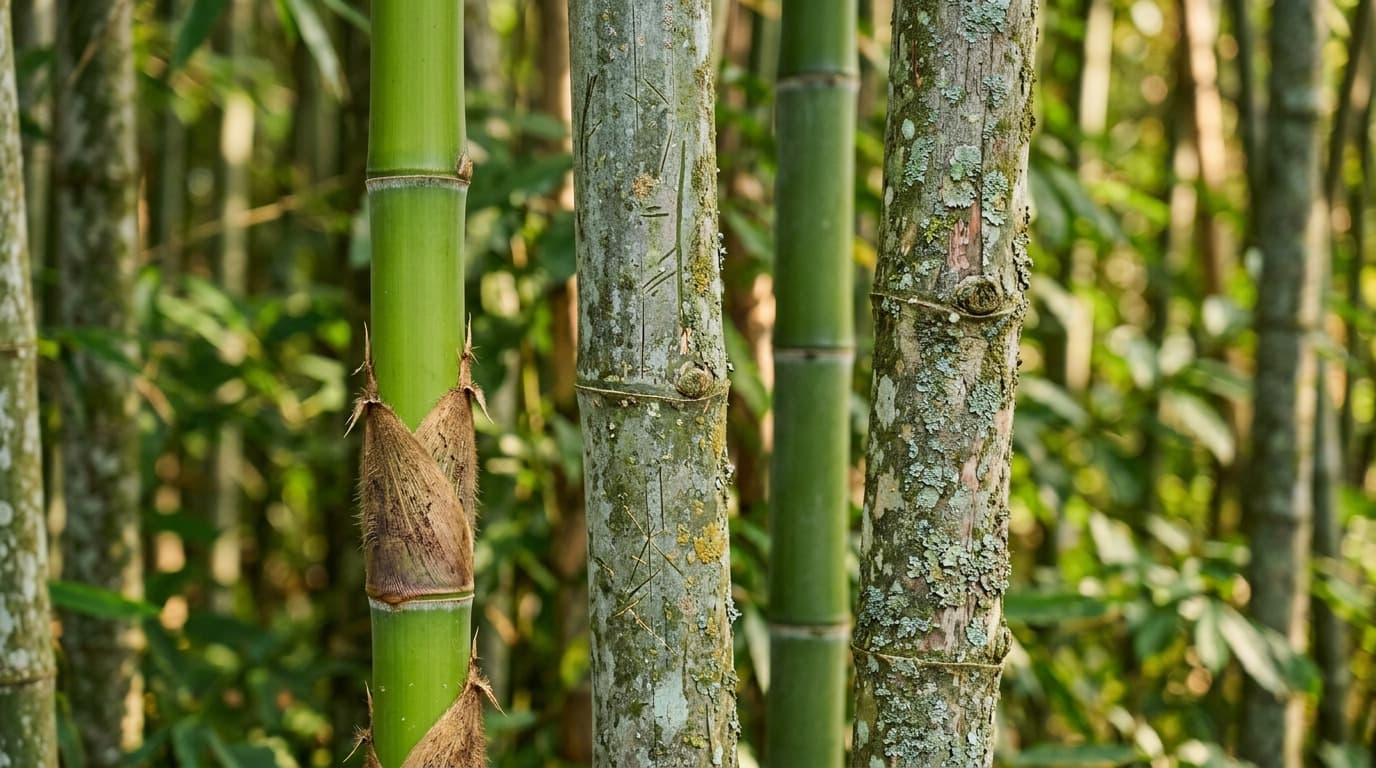
Culms can be identified by age through visual inspection: Year 1 culms have intact sheaths and a fresh green colour. Year 2 culms are clean, bright green. Year 3+ culms develop lichens, duller colour, and visible weathering. This visual system allows workers to select the correct culms during harvest.
First Structural Selection — Year 3
The first selective harvest takes place when the field is approximately 3 years old. At this point, the original planting culms (now aged) are removed to make room for the newer, larger culms that have emerged. This is the critical transition from establishment to productive management.
| Culm Age | Status | Action |
|---|---|---|
| Year 1 (new shoots) | Fresh, still growing | Keep 100% |
| Year 2 | Maturing, feeding rhizome | Keep 100% |
| Year 3 (original planting) | Aged, small diameter | Cut 20–30% |
Troubleshooting: Too Many Small Culms
If a field produces an excessive number of small-diameter culms, it typically indicates the stand is too dense. The solution is thinning — removing older and smaller culms to allow more light and resources for new growth. A well-managed field should show progressively larger culms each year.
⚠ Troubleshooting: Too Many Small Culms
| Cause | Action | Indicator |
|---|---|---|
| Too many old culms | Four Cuts: thin >3yr by 30–50% | Grey/faded, heavy lichen |
| Overcrowding / nutrient deficiency | Reduce density to 2,100–3,000 culms/ha | >3,500/ha, yellow leaves |
| Rhizome exhaustion | Reduce harvest 20–30%, fall NPK (Sept–Oct) | History of >50% harvest, cracked soil |
Cut & Maintenance — Years 4–6
(Transition Period)
| Year | Year 1 Culms | Year 2 Culms | Year 3+ Culms |
|---|---|---|---|
| Year 4 | Keep 100% | Keep 100% | Cut 30–50% |
| Year 5 | Keep 100% | Keep 100% | Cut 50–70% |
| Year 6+ | Keep 100% | Keep 100% | Cut 100% |
Cleaning & Density
Four Cuts, Four Retains
The guiding principle for stand maintenance: Cut dead, damaged, diseased, and oldest culms. Retain healthy young culms, well-spaced culms, and the best mature culms.
Target Density & Cutting Technique
The target density depends on species and purpose. For timber bamboo (Phyllostachys edulis), a spacing of roughly 1.5–2 m between culms is ideal. Cuts should be made as close to the ground as possible, using a sharp machete or saw. Clean cuts prevent water collection and rot.
Post-Harvest Handling & Safety
Harvested culms should be removed from the field promptly to prevent tripping hazards and pest harborage. Cut stumps should be inspected — if water collects in hollow stumps, they should be split or filled.
Professional Shoot Production
Mother Culm Concept
For edible shoot production, a "mother culm" system is used. Selected healthy culms are retained as mother culms — their role is to feed the rhizome system and produce the next generation of shoots. A ratio of approximately 3–5 mother culms per shoot harvest area ensures sustainable production.
Lateral buds on 2-year culms are the most productive for shoot generation. Energy flows from mature leaf canopy through the culm into the rhizome, fuelling new shoot emergence.
Their lateral buds have maximum energy. Removing too many 2-year culms directly reduces next season's shoot yield. Always retain the best 2-year culms as mother culms.
EU Shoot Harvest Calendar
In European climates, the main shoot season runs from April to June for most Phyllostachys species. Some species produce winter shoots from November to February. The exact timing depends on species, local climate, and soil temperature.
| Region | Early | Peak | Late |
|---|---|---|---|
| Netherlands / Belgium | Mar | Apr – May | Jun |
| Northern France / UK | Mar | Apr – May | Jun |
| Southern France | Feb – Mar | Mar – May | Jun |
| Spain / Portugal | Feb | Mar – May | Jun – Jul |
| Italy / Greece | Feb | Mar – May | Jun |
Climate & Multiple Shoot Seasons
In warmer Mediterranean climates (southern Spain, Portugal, Italy), some bamboo species can produce shoots in multiple seasons. Climate warming is also shifting and extending the traditional shoot calendar in more northern locations.
Soil Mounding & Harvest Strategy
Mounding soil around emerging shoots (similar to asparagus production) produces longer, more tender shoots by blanching. Shoots should be harvested when they are 20–40 cm above the mound surface. Harvest early in the morning for best quality.
Post-Harvest Shoot Handling
Fresh bamboo shoots are perishable. After harvest, remove outer sheaths, trim the base, and cool immediately. Processing should begin within hours of harvest for best quality and food safety.
- •Remove outer sheaths
- •Trim the base
- •Cool immediately
- •Keep shaded and moist
- •Insulated containers
- •Avoid direct sunlight
- •Maintain cool chain
- •Handle gently — bruising reduces value
- •Refrigerate at 2–5°C
- •High humidity environment
- •Use within 48 hours fresh
- •Process immediately for best quality
- •Boil to remove glycosides
- •Slice, vacuum-pack, or dry
- •Follow food safety standards
- •Label with harvest date
Production & Sources
3-Year Production Cycle
The sustainable bamboo production model operates on a rolling 3-year cycle: Year 1 shoots emerge and grow to full height, Year 2 culms mature and harden, Year 3 culms reach structural maturity and are ready for harvest. This creates a perpetual production system with annual harvests.
New shoots emerge and grow to full height and diameter in a single season (60–90 days). Culms begin to harden.
Culms mature and harden. Branches develop, leaf canopy expands. Primary shoot producers via lateral buds.
Culms reach structural maturity. Ready for selective harvest. Cut 100% of 3-year culms in steady state.
Technical Sources
Ready to start your plantation?
We provide technical support from soil preparation to harvest. Get in touch to discuss your bamboo project.